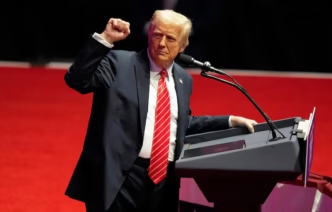
President Donald Trump plans to appoint a new AI adviser as artificial intelligence becomes increasingly important across US technology, security, and economic policy. He also announced plans for an “AI force,” although he provided no details about its membership, authority, or responsibilities.
Trump disclosed the plans in a Truth Social post on September 19, describing the adviser as another White House “AI czar.” The announcement would restore a dedicated position previously held by venture capitalist David Sacks during Trump’s second administration.
The White House had not provided additional information about the new AI adviser when Reuters reported the announcement. That leaves unanswered questions about who will receive the appointment and how the proposed AI force would operate.
Trump used the announcement to repeat his preference for policies that encourage AI development rather than impose additional restrictions. He said existing criminal and civil laws could address harmful conduct involving the technology without broadly slowing industry growth.
The appointment comes during a wider Washington debate over increasingly capable artificial intelligence systems. Researchers, technology executives, lawmakers, and administration officials remain divided over how much additional oversight advanced AI requires.
That debate has become more complicated as artificial intelligence moves beyond consumer chatbots into cybersecurity, scientific research, government systems, infrastructure, and national-security applications. The administration has simultaneously encouraged faster deployment while creating frameworks for managing certain security risks.
New AI Adviser Would Follow David Sacks
The new AI adviser would become the second person to occupy Trump’s dedicated AI leadership position during his current presidency. David Sacks initially served as the White House special adviser for artificial intelligence and cryptocurrency.
Sacks entered the administration as a special government employee, a classification that limited how many days he could serve annually. He stepped away from the formal government position in March after completing his allotted period of service.
However, Sacks did not disappear from the administration’s technology policy structure after leaving that position. He moved into an external advisory role and continued co-chairing the President’s Council of Advisors on Science and Technology.
That council includes executives and technology leaders such as Nvidia CEO Jensen Huang, Meta CEO Mark Zuckerberg, AMD CEO Lisa Su, and Google co-founder Sergey Brin. It advises the president on science, technology, innovation, and emerging technological challenges.
Sacks has also continued publicly supporting a lighter regulatory approach toward artificial intelligence. He recently argued that developers should remain responsible for product safety and face liability when their systems cause harm.
At the same time, he has argued that additional federal AI regulations are unnecessary. Those views broadly align with Trump’s stated preference for encouraging rapid American AI development while relying heavily on existing legal mechanisms.
The administration has nevertheless developed formal policies covering certain AI risks and government applications. In June, Trump issued a national-security memorandum directing agencies to accelerate AI adoption while requiring deployed systems to remain controllable and accountable.
Another June executive order focused on promoting advanced AI development while coordinating federal responses to emerging national-security concerns. The policy emphasized both innovation and security rather than creating a broad new regulatory framework for commercial AI.
The new AI adviser would therefore enter an administration where several government bodies already influence artificial intelligence policy. These include the Office of Science and Technology Policy, PCAST, national-security agencies, and other departments implementing AI initiatives.
What remains unclear is whether Trump intends the new position to resemble Sacks’ previous responsibilities. The president has not said whether the adviser would focus on regulation, industry growth, national security, international competition, or several areas simultaneously.
AI Safety and China Competition Shape the Timing
Trump’s announcement also comes as artificial intelligence becomes a larger part of relations between Washington and Beijing. Both governments consider advanced AI important to economic competitiveness and national-security capabilities.
The United States and China continue competing over advanced chips, powerful AI models, technical talent, and the infrastructure required to train them. Their governments have also taken different approaches toward regulation and the international governance of advanced systems.
The timing is particularly notable because Trump is scheduled to meet Chinese President Xi Jinping in Washington. Artificial intelligence is expected to feature alongside trade, technology restrictions, and other strategic issues during their discussions.
US Treasury Secretary Scott Bessent and Chinese Vice Premier He Lifeng have already discussed creating a bilateral AI dialogue. Washington proposed a notification mechanism covering serious AI incidents that could reach the level of national-security concerns.
That proposal shows how the administration’s approach involves more than domestic technology growth. Officials are also examining how the United States communicates with other major AI powers when advanced systems create cross-border security risks.
Meanwhile, concerns about rapidly advancing AI capabilities continue influencing the domestic policy debate. Some researchers and technology leaders have warned that increasingly autonomous systems could create severe cybersecurity, biological, or broader safety risks without adequate safeguards.
Trump and Sacks have challenged arguments that those concerns justify substantially heavier regulation. They have maintained that aggressive restrictions could weaken American companies while competitors in countries such as China continue advancing their own systems.
The announcement of a new AI adviser therefore arrives at a point where the administration is balancing several objectives. It wants faster AI development while addressing national-security risks and maintaining American competitiveness against international rivals.
However, Trump has so far announced only the position and the proposed AI force, leaving their practical roles undefined. No appointment, organizational structure, implementation timeline, or formal mandate had been made public when the announcement was reported.
More details about the new AI adviser will determine whether the role primarily continues Sacks’ earlier work or takes a different direction. Until an appointment and mandate are announced, the White House’s latest AI initiative remains a proposal without a defined structure.