Europe has spent years trying to reduce its dependence on foreign technology for powerful computing systems. That effort is beginning to show measurable progress. European supercomputing can now source far more critical components locally than it could only five years ago.
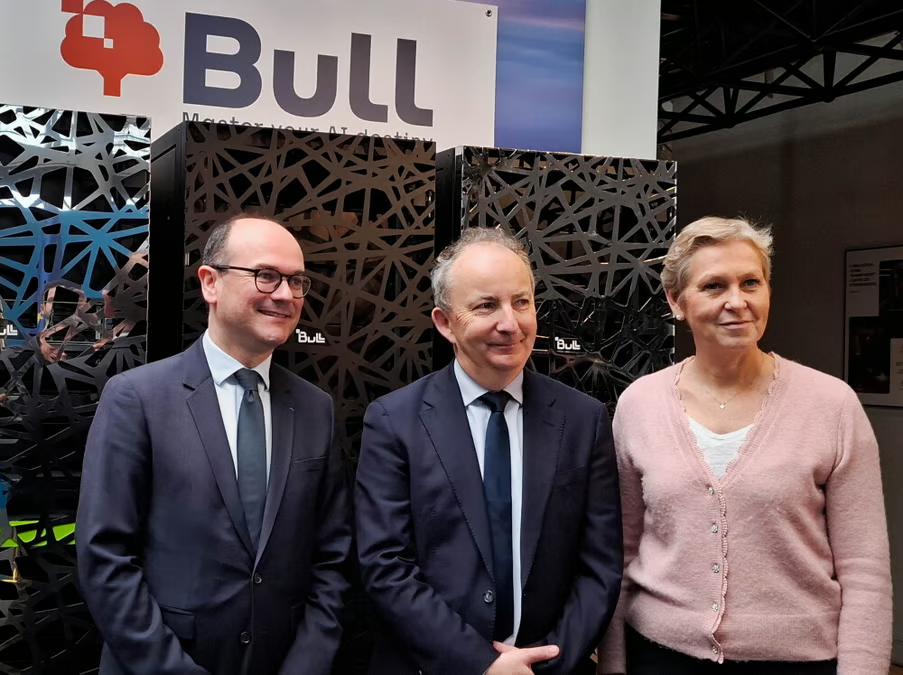
French supercomputer maker Bull says around 70% of the components in its systems can now come from European suppliers. That includes boards, cooling systems, interconnects, and increasingly processors. Memory remains the most important missing piece.
That gap matters because modern supercomputers consume enormous quantities of memory. Processors may perform the calculations, but memory keeps data available while those calculations happen. Without enough memory bandwidth and capacity, even powerful processors cannot operate efficiently.
The issue is becoming more urgent as artificial intelligence increases demand for high-performance memory. AI infrastructure requires huge quantities of DRAM and high-bandwidth memory alongside processors and accelerators. Europe currently lacks a large supplier capable of meeting that demand locally.
Bull’s latest manufacturing expansion shows how seriously Europe is treating the wider problem. The company opened a new production building in Angers, France, on October 2. Bull says the €80 million modernization will double production capacity for supercomputers, AI infrastructure, and enterprise servers.
The facility can design, integrate, assemble, test, and validate advanced computing systems within Europe. Bull presents the site as an important part of Europe’s push toward sovereign computing infrastructure. Yet European supercomputing still depends heavily on foreign memory manufacturers.
European Supercomputing Is Making Progress on Processors
Europe’s processor position looks very different from five years ago. Several companies are developing chips for high-performance computing, artificial intelligence, and data centers. SiPearl has become one of the most visible examples.
Its Rhea1 processor was developed through the European Processor Initiative. SiPearl describes it as the first high-performance European server CPU designed specifically for HPC and AI workloads. The processor contains 80 Arm Neoverse V1 cores and integrated high-bandwidth memory interfaces.
Rhea1 is expected to power part of JUPITER, Europe’s first exascale supercomputer. The system is operated by the Jülich Supercomputing Centre in Germany. SiPearl delivered the first Rhea1 processors to Bull for the project in September 2026.
This is an important milestone for European supercomputing. Europe historically relied heavily on U.S. processor companies for its most powerful machines. Building competitive processors locally gives governments more control over strategic computing infrastructure.
SiPearl is also developing processors for other sensitive environments. Its Athena1 chip targets defense, aerospace, government, and private data center workloads. The company expects commercial availability during the second half of 2027.
Europe is also preparing additional supercomputers around regional technology. The planned Alice Recoque exascale system in France is expected to incorporate future SiPearl processors. EuroHPC says the machine will support scientific computing, AI, medical research, climate modeling, and other advanced workloads.
These developments show that European supercomputing is gradually rebuilding capabilities that disappeared over previous decades. Processor design is returning, while companies are investing in networking and system integration. Cooling technology and server assembly also have strong regional suppliers.
However, even Europe’s sovereign processors reveal the remaining dependence. SiPearl designs Rhea1 in Europe, but TSMC manufactures the silicon in Taiwan. Its packaging also involves foreign manufacturing before later stages reach European systems.
True technology sovereignty therefore exists in degrees. Europe can own designs, intellectual property, system architecture, and assembly without producing every transistor locally. Memory remains more difficult because the supplier base is far more concentrated.
Memory Is Becoming the Hardest Part to Replace
The global memory market is dominated by a small group of manufacturers. Samsung, SK hynix, and Micron control most advanced DRAM production. Europe currently has no equivalent company operating at comparable scale.
TrendForce estimated Samsung held 39.4% of the DRAM market during the second quarter of 2026. SK hynix held 24.9%, while Micron controlled 23.3%. Together, those three companies accounted for nearly 88% of industry revenue.
Their dominance is even more important for European supercomputing because AI is pushing demand toward advanced server memory. High-capacity DDR5 and high-bandwidth memory are becoming essential components in AI clusters. Supply shortages have already pushed prices sharply higher.
TrendForce reported that server DRAM revenue jumped more than 50% during the second quarter. Average contract prices also rose by more than 50%. The research firm expects supply pressure and higher pricing to continue into 2027.
AI demand is one reason for that pressure. Memory manufacturers are dedicating more production capacity to high-value server products and HBM. That leaves less capacity available for other memory categories.
This creates a strategic vulnerability for European supercomputing. Europe could successfully design processors, manufacture servers, and build cooling systems while remaining dependent on imported memory. Any disruption affecting Asian or U.S. suppliers could still interrupt major projects.
Geopolitical tensions add another layer of risk. Advanced semiconductor supply chains stretch across Taiwan, South Korea, Japan, the United States, and other countries. Export controls or manufacturing interruptions can quickly affect availability.
Memory production is also extremely expensive to establish. New fabrication plants require billions of euros, specialized equipment, experienced engineers, and years of process development. A new European company cannot simply enter the market and immediately compete with Samsung or SK hynix.
That explains why Bull sees memory as the slowest gap to close. Europe has initiatives targeting semiconductor manufacturing, but advanced memory requires exceptional scale. Building a competitive European supplier would take significant capital and sustained political support.
AI Makes Europe’s Memory Dependence More Important
Supercomputing once primarily served government laboratories, scientific institutions, and specialized research centers. Artificial intelligence has dramatically widened demand for the same infrastructure. Companies now need similar hardware for training and running advanced AI systems.
European supercomputing therefore sits increasingly close to Europe’s broader AI ambitions. The European Union is investing in AI factories and large computing systems designed to support researchers and companies. These machines require enormous quantities of processors, accelerators, and memory.
SiPearl is already participating in projects connected with European AI factories. Its processors are planned for systems such as IT4LIA and future sovereign AI infrastructure. The company is also working with European partners on AI gigafactory proposals.
Bull’s Angers expansion follows the same trend. The company says its rebuilt factory will support demand for sovereign computing and artificial intelligence. Doubling manufacturing capacity gives Europe more control over final system production.
Yet memory increasingly determines how efficiently those machines operate. AI models move huge quantities of information between processors and memory. Faster processors provide limited benefits when the memory system cannot deliver data quickly enough.
High-bandwidth memory has therefore become particularly valuable. HBM places memory physically closer to high-performance processors and accelerators. This improves bandwidth while reducing some energy and communication bottlenecks.
The global HBM market is also concentrated among the same major suppliers. TrendForce says SK hynix, Samsung, and Micron remain the three principal manufacturers. Samsung increased its position during 2026 as HBM4 production expanded.
That concentration means Europe’s AI ambitions depend on companies outside the region. Even a fully European supercomputer design may still require imported memory components. The same challenge applies to many European AI data centers.
The situation does not mean Europe has failed in its semiconductor strategy. Moving from roughly one-quarter local sourcing toward 70% represents substantial progress. It shows targeted industrial policy and private investment can rebuild parts of the supply chain.
However, European supercomputing also demonstrates how difficult complete semiconductor independence would be. Modern computing relies on highly specialized industries spread across several countries. Recreating every component domestically would require enormous investment.
Europe may therefore focus on strategic control rather than complete isolation. Owning critical processor designs, system architecture, networking, software, and manufacturing can still reduce dependence. Memory could remain an imported component while governments seek stronger supply agreements.
Longer term, Europe may still decide that advanced memory deserves greater investment. AI is transforming memory from an ordinary component into strategic infrastructure. Rising prices and limited suppliers strengthen the argument for additional regional capacity.
For now, memory remains the most visible missing link. Europe can increasingly assemble sophisticated machines using its own processors and engineering expertise. Yet those systems still depend on a handful of foreign companies to keep their data moving.
That makes memory more than another semiconductor category. It is becoming the final major obstacle in Europe’s attempt to build a more independent high-performance computing ecosystem.