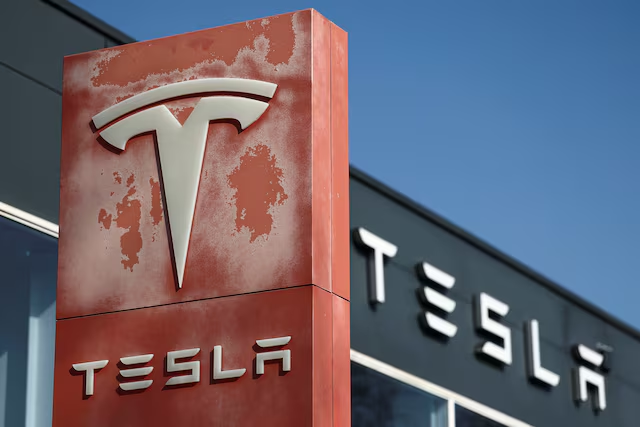
Tesla’s dominance in Europe’s electric vehicle (EV) market is evaporating at an alarming pace. After a brief recovery in September, the automaker’s sales plunged across major European countries in October, signaling that Tesla’s golden run on the continent may be coming to an end.
In Sweden, Tesla’s new car registrations, a key indicator of sales, plummeted 89%. In Denmark, they fell 86%, while Norway, once Tesla’s most loyal market, saw a 50% drop. These were the countries that once crowned Tesla as the undisputed EV leader. Today, they highlight how quickly the tides have turned.
France was the lone bright spot, with a modest 2.4% uptick, its second straight month of growth, yet still behind the nation’s overall auto market, which rose 2.9%.
Tesla’s downturn isn’t isolated. Across Europe, sales are down 28.5% year-to-date, compared with the same period in 2023. The culprit? A mix of stale product lineup, rising competition, and consumer fatigue with both the brand and its outspoken CEO, Elon Musk.
Norway’s slump is particularly symbolic. The country, where nearly all new vehicles sold are electric, once represented Tesla’s strongest foothold. But that loyalty is fading fast. New entrants, from China’s BYD, Xpeng, and Geely’s Zeekr to updated offerings from Volkswagen and BMW, are capturing market share with cheaper, more diverse, and better-designed EVs.
Ginny Buckley, CEO of Electrifying.com, summed it up bluntly: “Car buyers have more choice than ever, with an influx of new EVs from established manufacturers and ambitious newcomers from China. Tesla no longer has the market to itself, and that’s showing in its sales figures.”
In Denmark, Chinese automakers outsold Tesla entirely in October. Meanwhile in Sweden, Tesla sold just 133 vehicles, trailing behind Porsche’s 172. Year to date, its Swedish sales are down 67% compared to last year.
Beyond competition, Tesla is also grappling with a reputation issue. Elon Musk’s increasingly political persona, including vocal support for Donald Trump and far-right movements in Europe, has alienated a segment of European consumers. Once seen as a symbol of clean innovation and forward thinking, Tesla’s brand image is becoming more divisive.
Internally, the company is also under pressure. Reports indicate Tesla is quietly exploring backup CEO candidates, as Musk threatens to step away if his controversial $1 trillion pay package doesn’t pass.
For nearly a decade, Tesla embodied the future of driving in Europe, fast, futuristic, and aspirational. But that narrative is shifting. Chinese EVs are rising fast, legacy automakers have caught up, and consumers are no longer dazzled by the Tesla name alone.
As Europe moves deeper into an era of EV abundance, the market that Tesla once ruled is becoming its biggest challenge.