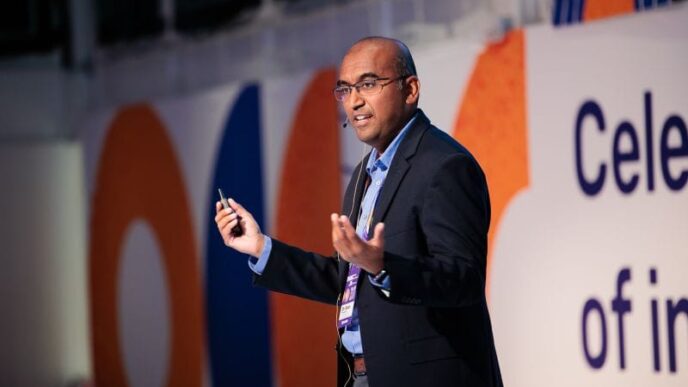

Micro1 has become one of the fastest growing companies in the AI ecosystem, and its latest revenue milestone shows why many inside the industry are paying close attention. The startup began this year with about seven million dollars in annual recurring revenue, yet it now claims to have surged past one hundred million dollars in ARR. Its founder and CEO Ali Ansari said that this leap reflects a broader shift in how AI labs rely on human insight to strengthen model performance.
The company is only three years old, but its pace puts it in the same conversation as some of the strongest players in the AI data training market. The jump is even more striking when viewed against its September numbers, when Micro1 announced a thirty five million dollar Series A round at a five hundred million dollar valuation.
Ansari, who is only twenty four, said at that time that Micro1 works with major AI labs including Microsoft and several Fortune 100 enterprises. These companies want better ways to refine large language models and reinforcement learning systems, and they need qualified human experts to do it. Micro1’s ability to recruit, vet, and manage those experts has become its strongest selling point.
That demand is rising fast. Ansari believes the market for high quality human data sits around ten to fifteen billion dollars today but could rise to nearly one hundred billion dollars within two years. The hunger for better model evaluation has grown even more intense after reports that OpenAI and Google DeepMind pulled away from Scale AI following Meta’s fourteen billion dollar investment in the vendor and its decision to hire Scale’s CEO. Competitors like Mercor and Surge have surged as well, with Mercor reportedly earning more than four hundred fifty million dollars in ARR and Surge reaching around one point two billion dollars in 2024.
Even with this explosive revenue climb, Micro1 still trails these larger rivals. Yet Ansari argues that its velocity matters more than the distance. The company’s roots explain some of that momentum. Micro1 originally launched as an AI recruiting tool called Zara. The team matched engineers with software jobs before shifting into the data training space, and that early product now evaluates and interviews applicants who want to join the expert network. Because of that history, Micro1 can bring qualified experts into its system far faster than traditional staffing methods.
While its current revenue comes mostly from elite AI labs and AI focused enterprises, Ansari believes the next wave of growth will come from two emerging segments that are still mostly under the radar. The first wave involves non AI native Fortune 1000 companies. These companies are beginning to build internal AI agents that handle support operations, workflow automation, financial analysis, and industry specific tasks.
Creating these agents requires ongoing evaluation. Teams must test frontier models, examine their outputs, choose which models perform best, and fine tune them for real environments. They also need a constant loop of human validators to monitor how the agents behave once deployed. Ansari believes this cycle will push human expertise to the center of enterprise AI development.
The second wave comes from robotics. Pre training robotics models requires very high quality human demonstrations of routine physical tasks. Micro1 already runs a program to capture these demonstrations from hundreds of generalists who record object interactions inside their homes. The company hopes to build the world’s largest dataset for robotics pre training. As Ansari explained, robotics companies cannot scale into homes and offices without vast amounts of this data, and that opens the door to a new category of human powered training work.
He expects both segments to reshape how companies allocate product budgets. Ansari believes that non AI native enterprises will soon spend a growing share of their product investments on evaluations and human data. He predicts that this share could rise from zero to at least twenty five percent of product budgets in the coming years. He also believes robotics labs will become major contributors to the market as their need for training data grows.
Despite the potential in these newer markets, Micro1’s growth today still comes mainly from advanced AI labs pushing the limits of reinforcement learning. These groups depend on continuous feedback cycles to test prompts, refine responses, measure accuracy, and correct model behavior. Micro1 supports these processes by supplying specialists across hundreds of domains. Many of these experts earn close to one hundred dollars an hour, which Ansari says reflects the value of their skill and the complexity of the tasks.
The size and diversity of the expert network surprise many outsiders. Micro1 now manages thousands of specialists, and their backgrounds range from technical fields to hands on and deeply offline areas. Some are Harvard professors or Stanford PhDs who spend part of their week evaluating AI models. Others come from less expected disciplines that still provide useful insights for language model training.
Even with the positive momentum, Ansari says Micro1 wants to expand with caution. The company’s rise has turned it into one of the most watched competitors in the human data market, and he believes that long term success depends on treating experts fairly. He says that building a responsible ecosystem around human contributors matters even more as AI companies automate more of their own pipelines.
Micro1’s early push into robotics data and enterprise agent evaluation could help it carve out additional market share as the data race intensifies. Many AI companies now accept that model performance depends heavily on curated human insight, and the firms that can deliver that insight at scale may define the competitive landscape. Micro1 wants to be one of those firms, and its rapid jump to one hundred million dollars in ARR is the clearest signal that it has found the right market at the right moment.
Ansari believes the broader opportunity is even larger. He thinks human expertise will remain at the core of AI development for years, and he expects new categories of work to emerge as models become more capable. For now, Micro1 plans to keep expanding its expert network, refining the tools that support it, and exploring new verticals where human judgment can make AI systems safer and more reliable.
In his view, the next chapter of AI will be defined by how well companies integrate human insight into automated systems. That belief has shaped Micro1’s strategy since its early pivot, and it continues to guide how the company approaches its fast growing customer base. The market may be moving quickly, but Micro1’s leadership seems confident that it can grow just as fast while keeping people at the center of its work.