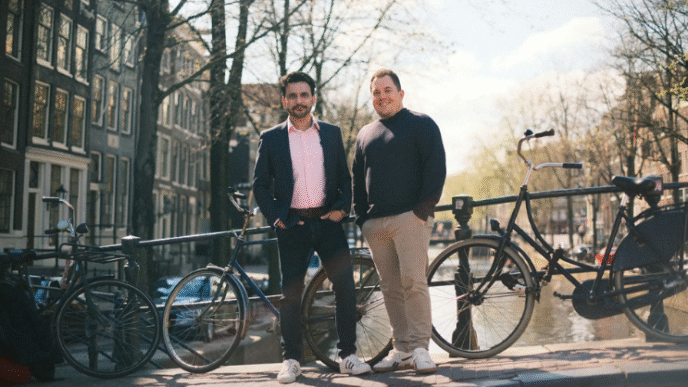
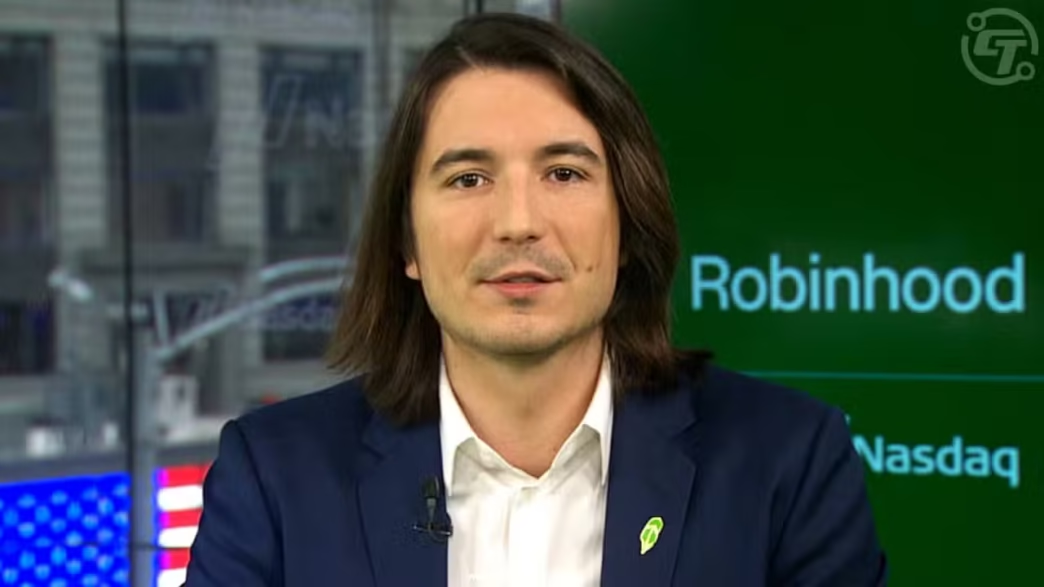
Harmonic AI has quickly become one of the most talked-about players in deep tech, and its rise just became even more dramatic. The Robinhood CEO–backed startup has raised $120 million at a $1.45 billion valuation, pulling in support from Ribbit Capital, Sequoia, Kleiner Perkins and new investor Emerson Collective. The round marks Harmonic AI’s third major raise in only 14 months, pushing its total funding to $295 million.
The company’s momentum comes from a very different vision of what reliable AI should look like. Instead of relying on statistical predictions, Harmonic AI is betting on a system built on strict logic. The team calls this approach Mathematical Superintelligence, and it aims to fix AI hallucinations at the root by teaching models to reason with verified steps rather than intuitive guesses.
Its flagship model, Aristotle, sits at the centre of this push. The model learns through synthetic math proofs and computer-generated problems that force it to produce answers grounded in logic. This shift has started to attract global attention. In July, Aristotle competed at the International Mathematical Olympiad and landed a top-tier score that placed it alongside research from Google and OpenAI. That performance sparked a rush of investor interest and signalled that Harmonic AI was building something far more rigorous than typical generative systems.
Harmonic’s approach requires every step of a model’s reasoning to be written as executable code in the Lean4 programming language. Each step is checked for accuracy, which means the final output is built on a foundation developers can verify. This mirrors how mathematicians craft proofs. It also moves AI away from the guess-driven behaviour that often leads to hallucinations.
Because this level of precision demands heavy computing power, the new funding will go straight into scaling and training larger models. Harmonic AI believes this is essential for industries that cannot afford even minor mistakes. Aerospace, finance, and other high-risk sectors depend on accuracy. For them, trust is not optional, and Harmonic wants its technology to meet that bar.
For now, the startup is not focused on revenue. Aristotle is available through a free API that developers, academics and mathematicians are already using to explore complex proofs and push new theoretical ideas forward. Tasks that once took months of manual work can now be tested and verified in a fraction of the time.
Commercialisation will come later, but the company wants to secure its lead in logic-driven AI first. As demand grows for systems that produce consistent, error-free results, Harmonic AI has positioned itself as a contender determined to rebuild AI from the ground up. The race toward dependable artificial intelligence is moving fast, and Harmonic AI is making the case that accuracy, not intuition, will define the future.