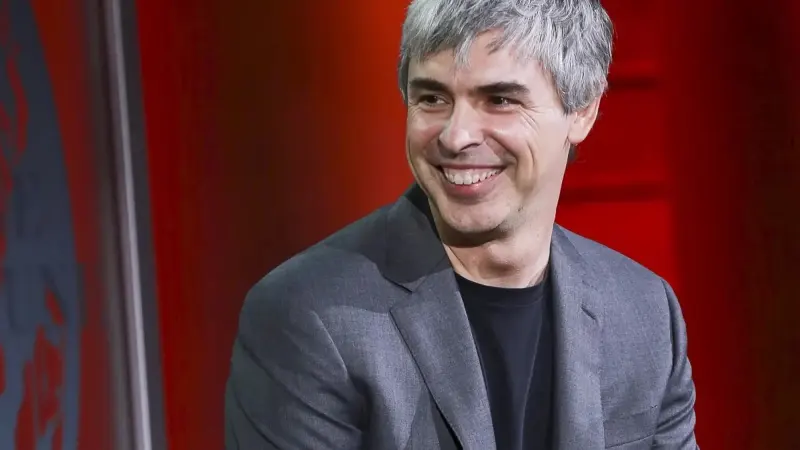
Larry Page’s rise has taken another dramatic leap as his net worth hit an estimated $255 billion, making him the world’s second-richest person. The surge in Larry Page net worth comes at a moment when Alphabet is enjoying one of its strongest rallies in years, powered by the rapid progress of its AI strategy and the launch of its newest flagship model, Gemini 3.
The climb past Oracle founder Larry Ellison marks a symbolic shift in the tech world. For years, Ellison held onto a stable position among the top three richest people globally. But as Oracle’s stock softened, Alphabet moved in the opposite direction, with AI becoming the engine behind Page’s outsized gains.
The growth of Larry Page net worth over the last five years reads like a story of relentless momentum. In 2020, Page was worth around $50.9 billion. By the start of 2025, that figure had already soared above $144 billion. The recent milestone pushes him past the quarter-trillion mark, an extraordinary jump shaped by both market confidence and Google’s reinvention around AI.
A single trading day added another $8.7 billion to his fortune after Alphabet shares spiked on the back of strong Q3 earnings. That jump wasn’t just about numbers on a spreadsheet. It reflected investors’ growing belief that Google’s shift to an AI-first company is paying off at unprecedented scale.
Page holds about 3.2% of Alphabet, which means every market movement has an immediate impact on his personal fortune. That stake has turned into a wealth-acceleration machine thanks to Alphabet’s 67% rally in 2025 alone. Investors have re-evaluated Google, not as a search company, but as a global AI powerhouse positioned to challenge leading models from OpenAI and others.
The release of Gemini 3, Google’s most advanced AI model to date, played a major role in the latest surge. It marked a turning point, showcasing multimodal abilities, higher reasoning accuracy, faster response times, and stronger enterprise adoption. For many investors, the launch served as proof that Alphabet is not only catching up in AI but starting to pull ahead in areas that matter.
This shift in momentum reshaped billionaire rankings in real time. While Larry Page net worth soared, Larry Ellison saw a decline linked to weaker performance in Oracle’s cloud and enterprise AI divisions. The contrast shows how dramatically fortunes can change depending on a company’s ability to ride the AI wave.
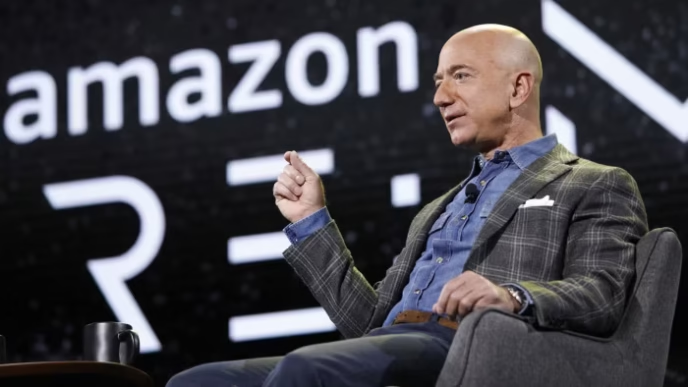
The ripple effects extended beyond Page. Sergey Brin, Page’s longtime co-founder, also climbed the global wealth rankings. His fortune rose enough to surpass Jeff Bezos, securing the number four spot worldwide. That movement underlines how central AI has become—not just to products or strategy, but to the hierarchy of global wealth.
Alphabet’s rise is not an isolated moment. The entire tech sector is reorganizing around AI adoption, chip demand, and infrastructure expansion. Yet Google’s resurgence stands out because it follows years of pressure from competitors and questions about whether the company had lost its edge. Instead of falling behind, Google used its huge data reserves, research capabilities, and computing power to rebuild its position.
Larry Page, though largely quiet and outside the spotlight, remains one of the most influential figures behind the scenes. Even though Sundar Pichai leads Alphabet day-to-day, Page’s long-term bets on AI, self-driving cars, and moonshot projects are now defining where the company, and the industry, is heading.
There’s also a broader theme at play. The rise in Larry Page net worth shows how AI-driven growth is redrawing the lines of global wealth faster than any previous tech cycle. In earlier eras, fortunes grew around search, social networks, and smartphones. Today, AI is the central force, moving markets with every model release, benchmark result, and enterprise partnership.
The transition from search-based dominance to AI-native leadership has given Alphabet a renewed sense of direction. Investors are rewarding companies that not only develop AI models but have the infrastructure, data, and product ecosystem to scale them. Google fits that profile, which is why its valuation, and Page’s fortune, have surged at such speed.
As Google accelerates its work on reasoning models, chip design, and native AI products across YouTube, Search, Workspace, and Android, the company’s long-term trajectory looks even more ambitious. These moves reinforce why Larry Page net worth continues to climb: he is tied to one of the few companies positioned to shape how AI integrates into everyday life.
This new era of tech wealth also highlights the importance of innovation cycles. Just as cloud and mobile once reshaped the competitive landscape, AI is doing the same today. Companies thriving in this environment are those that can adapt quickly, ship reliably, and meet the market with strong signals. Alphabet’s recent run shows that its AI shift is resonating far beyond Silicon Valley.
Meanwhile, Elon Musk remains at the top of the global leaderboard with an estimated net worth of around $475 billion. But the gap between Musk and Page is narrowing faster than expected, especially as AI becomes more central to both tech and investment narratives.
If Alphabet’s growth continues at its current pace, the ranking could shift again in ways few predicted just a year ago. Page’s rise offers a glimpse into what happens when a tech giant repositioned around AI achieves both speed and scale at the same time.
In the bigger picture, the ascent of Larry Page net worth is more than a number. It’s a marker for how AI has created a new competitive advantage that influences everything from product adoption to investor psychology. As Alphabet expands its AI strategy, the impact will continue to ripple through markets, and the wealth rankings that follow them.